

Your procurement team just forwarded a 400-row Excel sheet from a critical vendor claiming their model is "safe." Two days later, a news report breaks that the same model leaked PII during a re-training cycle. Now you are holding a worthless, static spreadsheet while the regulators queue up.
This is the reality of AI governance for many organizations in 2026. We are drowning in "compliance theater." Vendors email static questionnaires to partners, partners email them back, and the actual evidence of safety—the logs, the training data lineage, the bias testing results—is lost in a labyrinth of Slack threads and Google Drives.
This chaotic evidence tracking is a silent killer. It creates a false sense of security while actual control over your AI systems erodes.
Resistance to "another formality with high cost" is understandable. You likely spent 2024 and 2025 fighting budget battles. But avoiding a structured framework is creating legal debt—a liability that compounds every time you deploy a model without a traceable audit trail.
When—not if—a model fails, the first question from a judge or an auditor will not be "Did you mean well?" It will be "Show us the decision log."
If your answer relies on a three-month-old spreadsheet, you are exposed to specific, high-value risks:
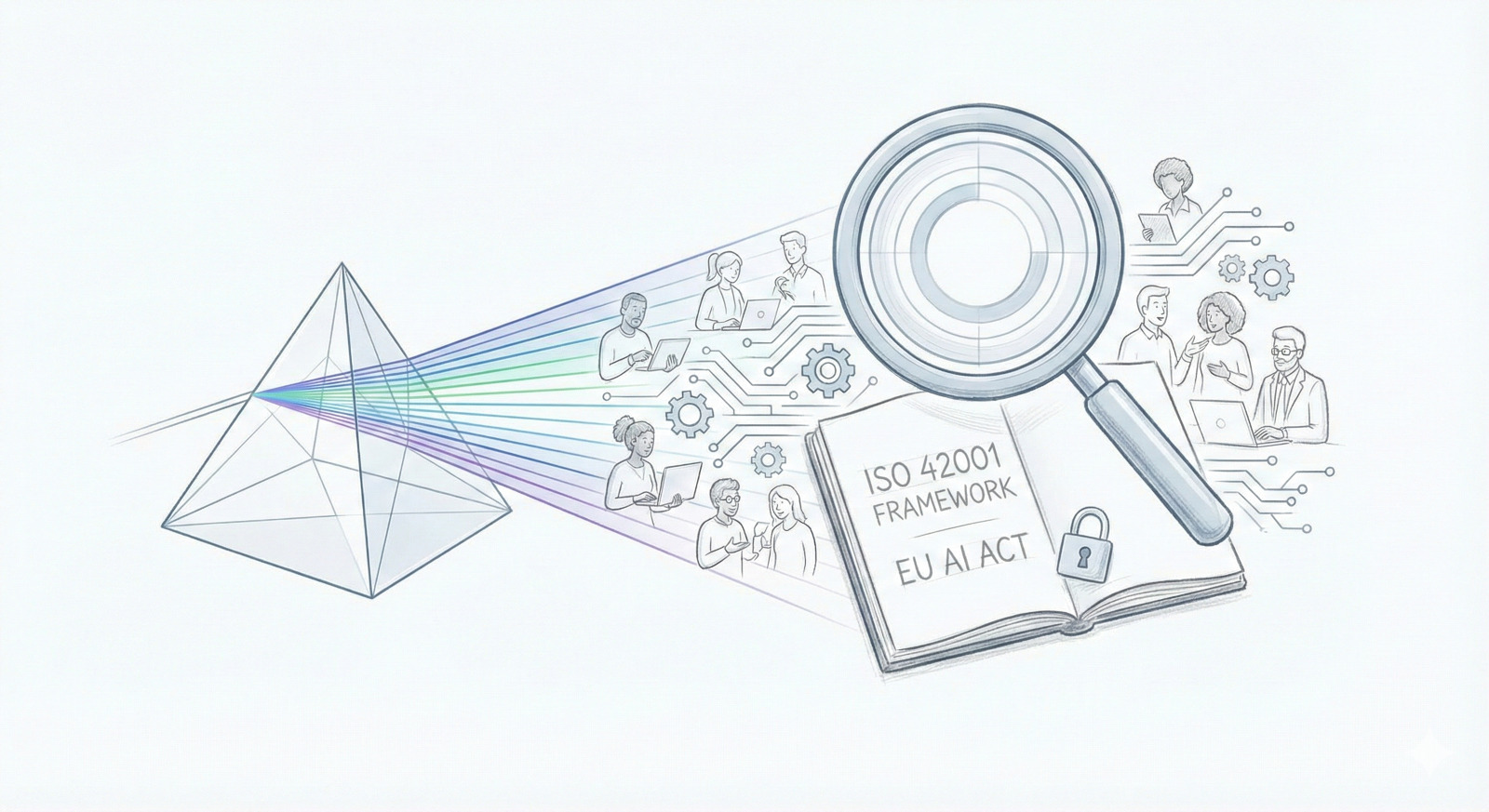
ISO 42001 shifts the focus from "checking a box" to "managing a system." It is currently the most effective way to stop the spreadsheet shuffle.
Unlike a static checklist, ISO 42001 requires an AI Management System (AIMS). This means:
Let’s be frank: ISO 42001 is boring work. It is not cheap, and it is not fast. Not for now.
You are trading speed today for survival tomorrow.
Stop treating AI governance as a paperwork problem. It is an engineering integrity problem.
Immediate Action: Audit your current "evidence locker." If your proof of compliance lives in email attachments or spreadsheets, you are carrying dangerous legal debt. Move to a centralized system of record immediately.
Regulatory stability is no longer optional for scaling. To avoid the trap of retroactive compliance and the massive technical debt of rebuilding models, organizations must move from passive documentation to active enforcement. We are developing a state-of-the-art AI governance system designed to replace manual tracking with verifiable engineering controls.